


The Architecture of Control: Are Cities Secretly Designed to Shape Human Behavior?
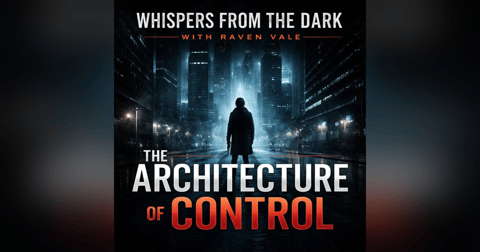


Your city is not a backdrop. It is an instrument — and it is playing you.
Are cities designed for convenience or control? Raven Vale investigates the hidden psychology behind urban design, surveillance architecture, and behavioral engineering.
There is a moment that happens in every city. You step off a train, or out of your car, or emerge from underground into open air — and something shifts inside you. Your pace changes. Your posture adjusts. Your voice drops without thinking.
No one told you to do any of that. The design did.
In this episode of Whispers From the Dark, host Raven Vale takes a deep, unsettling look at the hidden science of urban design — the deliberate, documented, and often invisible ways that cities engineer human behavior at scale.
This is not a theory. It is environmental psychology, and it has been shaping your daily experience your entire life.
What you'll discover in this episode:
Raven opens with the contrast between the financial canyons of Lower Manhattan — where strangers walk faster, speak less, and keep their eyes forward — and the deliberately open, chamfered intersections of Barcelona's Eixample district, where the same human beings breathe differently, move more slowly, and feel, inexplicably, more at ease. The difference is not culture. It is geometry.
From there, the episode moves into the documented psychology of architectural design: how sharp angles and vertical dominance communicate authority and induce compliance, how ceiling height literally alters human cognition, and why the most powerful institutions in every city are built to make you feel small.
Raven examines the maze effect of suburban cul-de-sac design — how winding, non-linear neighborhoods create territorial exclusion through spatial confusion — and contrasts it with the surveillance properties of the urban grid. She then traces the lineage of modern urban surveillance directly to Jeremy Bentham's eighteenth-century Panopticon: the prison in which behavior was controlled not by chains, but by the constant possibility of being watched. A design principle that now appears in open plazas, glass lobbies, elevated highways, and camera poles on every major street.
The episode investigates lighting as emotional manipulation — the documented physiological differences between cool blue commercial lighting and warm amber residential hues — and how cities choose their light not for beauty, but for behavioral effect.
We examine crowd flow engineering in retail corridors and airports, the emotional temperature of cities as a product of material choice, and the openly debated but rarely discussed practice of hostile architecture — the spikes, the angled benches, the sloped ledges that exclude specific populations from public space without passing a single law.
Finally, Raven turns to the future: smart cities, adaptive lighting, real-time behavioral surveillance, and crowd prediction algorithms that allow governments and developers to shape behavior before it even occurs. The architecture of control is becoming more precise. The invisible hands are multiplying.
This episode does not claim a conspiracy. It makes something harder to dismiss: a documented, evidence-based argument that the built world around you is not neutral, that it was designed, and that it is working on you right now.
This episode is for anyone who has ever: — Felt inexplicably anxious in a modern financial district — Wondered why some neighborhoods feel welcoming and others feel hostile — Sensed they were being watched without seeing a camera — Asked why public spaces feel less and less like they belong to the public
Once you hear it, you cannot unhear it.
Whispers From the Dark — new episodes available wherever you listen to podcasts.
- urban design psychology
- city behavior control
- psychological architecture
- architecture and human behavior
- how cities control people
- urban surveillance design
- city design and mental health
- environmental psychology
- behavioral architecture
- panopticon urban design
- hostile architecture explained
- smart city surveillance
- urban planning psychology
- how buildings affect mood
- city design conspiracy
- architectural influence on behavior
- crowd flow design
- surveillance architecture
- Bentham panopticon modern cities
- how lighting affects behavior
- city design and emotions
- urban control mechanisms
- cul-de-sac design psychology
- defensive architecture
- cognitive effects of architecture
- why do I feel anxious in cities
- does architecture affect mental health
- how retail stores are designed to manipulate
- how cities are designed to control people
- why narrow streets make you uncomfortable
- environmental design and human psychology
- how urban planners shape behavior
- is city design a form of social control
- how does architecture influence cognition
- buildings that make you feel small
- Are cities designed to control human behavior through architecture?
- How does urban design influence the way people think and feel?
- What is the panopticon and how does it relate to modern cities?
- Why do I walk faster in financial districts than in residential neighborhoods?
- How does lighting in cities affect human mood and behavior?
- What is hostile architecture and who is it designed against?
- How do retail stores use design to slow down shoppers and increase spending?
- Why do some neighborhoods feel welcoming and others feel threatening?
- What is environmental psychology and how does it apply to urban design?
- How are smart cities using surveillance to predict and shape human behavior?
- What is the difference between urban grid design and cul-de-sac design psychologically?
- How does building height affect human cognition and decision-making?
- Why do glass and steel skyscrapers make people feel small and compliant?
- What is behavioral architecture and how do cities use it?
- How does tree cover in neighborhoods reduce crime and improve mental health?
- Can the design of a city cause anxiety or stress in its residents?
- What did Jeremy Bentham's panopticon prison design have to do with surveillance?
- How do airports use design to funnel passengers past commercial spaces?
- Is modern minimalist architecture bad for human psychological wellbeing?
- Who decides how cities are designed and whose interests do they serve?
- urban behavioral control
- architectural psychology
- panopticon cities
- hostile architecture
- smart city surveillance
- urban surveillance design
- city and behavior
- environmental psychology
- architecture and mood
- city mental health
- urban design conspiracy
- behavioral architecture podcast
- city control design
- surveillance urbanism
Are cities designed to control human behavior? A: Cities are not designed through a single coordinated conspiracy, but urban design consistently and deliberately influences human behavior through environmental psychology. Street geometry, lighting temperature, building height, sightlines, and material choices all produce documented, measurable effects on mood, movement, and compliance. This is an established field called behavioral or environmental psychology, and its principles are actively applied by architects, urban planners, and developers.
What is the panopticon and how does it relate to urban design? A: The Panopticon was an eighteenth-century prison design by philosopher Jeremy Bentham featuring a central watchtower from which all cells could be observed, while prisoners could not see whether they were being watched. The key insight was psychological: the possibility of constant surveillance changed behavior without requiring actual observation. Modern cities replicate this principle through open plazas, glass facades, strategic lighting, elevated highways, and camera networks — spaces designed so that people feel potentially visible at all times.
What is hostile architecture? A: Hostile architecture refers to urban design features that deliberately prevent certain behaviors — typically sleeping, loitering, or gathering — in public spaces. Examples include benches with center armrests that prevent lying down, metal spikes under bridges and ledges, and sloped surfaces where flat ground would otherwise provide rest. Critics argue that hostile architecture excludes homeless and low-income populations from public space without passing explicit laws.
How does lighting affect human behavior in cities? A: Lighting temperature and intensity produce measurable physiological responses. Cool blue light increases alertness and is used in financial districts and transit hubs to encourage productivity and movement. Warm amber light signals comfort and safety and is used in upscale residential and commercial zones. Harsh uniform lighting historically used in public housing communicated austerity. Cities strategically deploy these effects to influence the emotional state and behavior of their populations at scale.
What are smart cities and how do they affect behavioral control? A: Smart cities use embedded sensors, adaptive lighting, real-time surveillance analytics, and crowd prediction algorithms to monitor and respond to human behavior in real time. These tools allow urban planners and governments to shape pedestrian flow, dwell time, and public behavior with increasing precision. While proponents cite public safety benefits, critics note that smart city technology centralizes behavioral influence and reduces transparency around who controls urban environments and how.
What is environmental psychology in urban design? A: Environmental psychology is the scientific study of how physical spaces affect human thought, emotion, and behavior. In urban design, it examines how variables like ceiling height, street width, building geometry, material choices, lighting, and green space influence mood, movement, compliance, stress levels, and social behavior. Its findings are actively applied in the design of financial districts, retail spaces, public housing, transit hubs, and government buildings.
#WhispersFromTheDark #RavenVale #PsychologicalArchitecture #UrbanDesign #CityControl #BehavioralArchitecture #EnvironmentalPsychology #Panopticon #HostileArchitecture #SmartCity
#DarkPodcast #ConspiracyPodcast #TrueCrimePodcast #UrbanPsychology #ArchitectureAndMind #SurveillanceArchitecture #CityLife #UrbanPlanning #HiddenHistory #MindControl
#PodcastRecommendation #NewPodcast #ParanormalPodcast #DarkHistory #DeepDive #ThinkingDifferent #SystemsOfControl #WhoBuiltThisCity #UrbanMyths #YouAreBeingGuided
00:00 — Cold Open: The Moment of Shift 02:15 — Act I: The Feeling of a Place 06:30 — Act II: Geometry and Authority 10:45 — Act III: The Maze Effect 14:20 — Act IV: The Panoptic City 19:00 — Act V: Light as Emotion 23:30 — Act VI: Crowd Psychology and Flow 28:15 — Act VII: The Emotional Temperature of a City 33:00 — Act VIII: Defensive Design 36:45 — Act IX: Modern Minimalism and the Human Mind 40:30 — Act X: The Invisible Agreement 44:15 — Act XI: Emergence or Intention? 48:00 — Act XII: The Future of Behavioral Architecture 52:30 — Act XIII: The Quiet Power of Space 56:00 — Outro: Listen Closely
https://whispersfromthedarkpodcast.com
See Privacy Policy at https://art19.com/privacy and California Privacy Notice at https://art19.com/privacy#do-not-sell-my-info.