

Digital Doppelgängers — Who Owns Your Identity in the Age of AI?
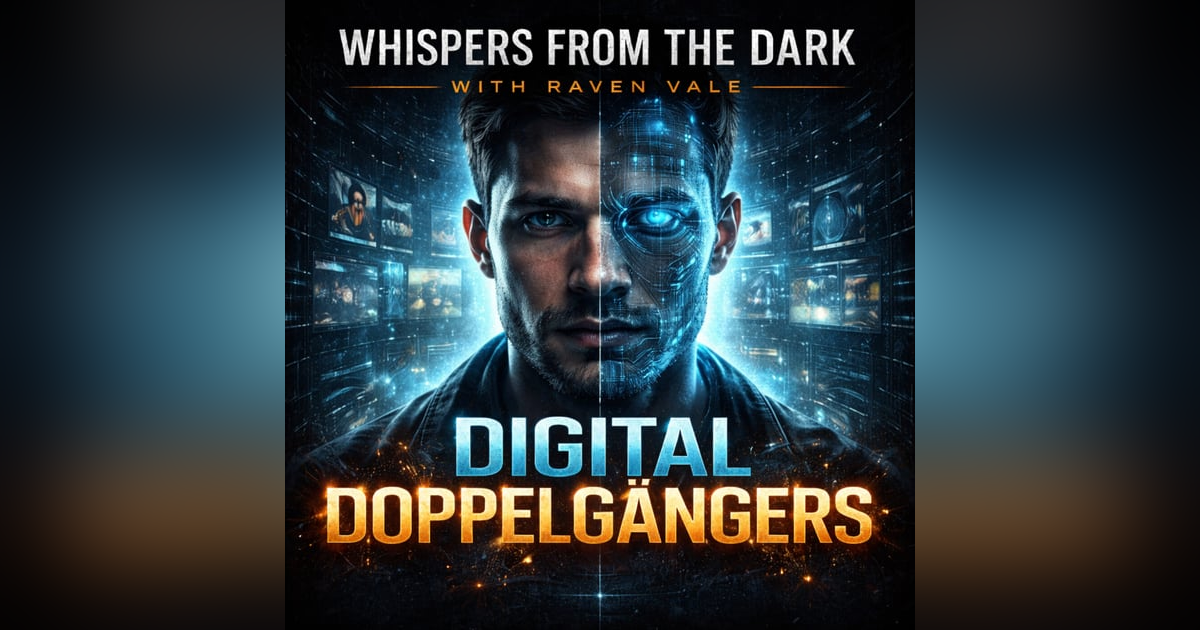


In German legend, the doppelgänger was not a monster. It was something more disturbing: a perfect double of a living person, walking the world without permission, wearing your face, doing things you never did.
The old stories called it an omen. A signal that the boundary between you and your copy had become permeable.
We no longer need legends to imagine this.
In this episode of Whispers From the Dark, host Raven Vale investigates the technological reality that the doppelgänger myth anticipated: AI systems capable of replicating your face, cloning your voice, simulating your personality, and deploying your digital likeness in ways you never consented to and may never know about.
Raven opens by tracing the deep, cross-cultural human anxiety about duplication — the indigenous fear of photography as soul extraction, the Eastern European folklore that warned a sighting of your double meant death — and follows that thread directly into the present, where the things our ancestors feared have become infrastructure.
The episode investigates AI voice cloning in forensic detail: how modern synthesis tools can replicate a person's specific vocal signature from just minutes of audio, producing results precise enough to deceive family members, and how that capability is already being deployed in fraud, manipulation, and unauthorized commercial use. The voice, once the most intimate proof of a person's presence, has become separable from the body that produces it.
It examines deepfake technology — the acceleration of video generation capabilities that allow AI to produce hyper-realistic footage of real people doing things they never did — and the cascading consequences for trust in visual evidence, political information, personal reputation, and the legal systems built around the assumption that recordings reflect reality.
Raven explores the emerging industry of digital resurrection: companies that build interactive AI simulations of deceased individuals from their archived digital data, offering grieving families continued access to something that sounds, responds, and reasons like the person they lost. The compassion of the intent does not resolve the ethical complexity of the practice — or the question of who owns the result.
The episode turns to the economy of identity: the documented, systematic process by which faces train facial recognition models, voices train speech synthesis, behavioral patterns train predictive algorithms, and data brokers compile and sell profiles of real individuals — all largely without meaningful consent, and all producing systems that carry something derived from specific people without those people having any rights over what is done with what was taken.
It confronts the concept of modern digital possession: the scenario in which your likeness acts independently of you in the world — making statements you did not make, appearing in contexts you did not choose, generating consequences you must live with — while your body remains entirely innocent and entirely uninvolved.
And it closes with the questions that matter most: who legally owns your digital double, what happens to trust when nothing digital can be reliably verified, and whether identity is something that can be owned at all — or merely something that can be borrowed, without asking, without returning, without ever announcing that the borrowing began.
This episode is for anyone who has ever: — Wondered what AI companies are actually doing with the data they collect — Been unsettled by how convincing deepfake videos have become — Asked what rights they have over their own voice and likeness online — Thought about what digital resurrection technology means for grief and memory — Wanted to understand AI identity theft beyond the headlines — Sensed that the digital world is accumulating versions of them they have never seen
The copy does not ask permission.
And it does not stop when you do.
Whispers From the Dark — available wherever you listen to podcasts.
- AI identity theft
- deepfake technology explained
- AI voice cloning
- digital doppelganger AI
- who owns your digital identity
- AI face replication
- digital resurrection AI
- AI likeness rights
- deepfake voice cloning
- artificial intelligence and identity
- AI digital twin ethics
- voice cloning fraud
- deepfake detection
- AI and privacy rights
- synthetic media ethics
- digital afterlife technology
- AI generated video risks
- biometric data rights
- consent and AI training data
- deepfake political manipulation
- AI immortality technology
- identity rights digital age
- data scraping and identity
- AI avatar ethics
- likeness rights law
- can AI clone your voice from recordings
- who owns an AI generated version of you
- deepfake technology dangers explained
- is it legal to train AI on someone's voice
- what is digital resurrection technology
- how data brokers use your identity
- AI deepfake fraud how it works
- what happens to your data after you die
- can you be legally protected from deepfakes
- the psychology of seeing your digital double
- Who legally owns an AI-generated replica of your face or voice?
- Can someone clone my voice using AI without my permission or consent?
- What is deepfake technology and why is it dangerous for ordinary people?
- How do AI companies use your photos and voice recordings for training data?
- What are the ethical implications of using AI to resurrect deceased people digitally?
- How does AI voice cloning work and how accurate can it really be?
- What legal rights do I have over my digital likeness and voice online?
- How can deepfake videos be used to manipulate elections or destroy reputations?
- What is a digital doppelganger and how is AI creating them from real people?
- How does data scraping turn your personal information into AI training material?
- What is digital resurrection technology and how do grief apps use dead people's data?
- Can AI generate realistic video of a person doing something they never did?
- How does modern AI voice fraud work and how can you protect yourself?
- What is the difference between a deepfake and a legitimate AI-generated avatar?
- How is the loss of digital trust affecting institutions and social systems?
- What happens when your AI-generated likeness says something you would never say?
- How do biometric authentication and digital watermarks fight AI-generated fakes?
- What philosophical questions does AI identity replication raise about the self?
- How are laws around AI likeness rights changing in response to deepfake technology?
- Is there anything about human identity and consciousness that AI cannot replicate?
- AI voice cloning
- deepfake technology
- digital identity theft
- AI face replication
- voice clone fraud
- digital resurrection AI
- likeness rights AI
- synthetic media risks
- AI doppelganger
- deepfake detection
- AI privacy rights
- biometric data theft
- AI afterlife app
- consent AI training
- identity AI law
What is AI voice cloning and how does it work? A: AI voice cloning is the process of using machine learning models to replicate a specific person's voice — including their tone, cadence, emotional inflection, and breath patterns — from recorded audio samples. Modern voice synthesis tools can produce convincing replications of a person's voice from as little as a few minutes of audio, generating new speech in that voice on any text input. The technology is being used legitimately for accessibility tools, entertainment, and productivity software, and illegitimately for fraud, manipulation, unauthorized commercial use, and the fabrication of statements that targeted individuals never made.
What is a deepfake and why is it dangerous? A: A deepfake is an AI-generated video or image in which a real person appears to do or say something they never actually did or said, created using deep learning systems trained on existing footage and photographs of that individual. The technology has advanced rapidly, moving from novelty to widely accessible capability within a few years. Deepfakes are dangerous because they can be used to spread political disinformation, fabricate evidence, damage personal reputations, create non-consensual intimate imagery, and undermine public trust in visual media — eroding the assumption that recorded footage reflects reality.
Who owns your digital likeness under AI law? A: Legal ownership of AI-generated digital likenesses is an evolving and contested area of law. In most jurisdictions, a person has inherent rights over their image and likeness that prevent others from commercially exploiting their appearance without consent. However, AI training data compiled from publicly available content — photographs posted online, publicly accessible recordings — often exists in a legal grey zone where existing privacy and intellectual property frameworks do not clearly prohibit its use. Some jurisdictions are passing specific AI and digital likeness legislation, but legal protection varies widely and generally lags behind the pace of technological development.
What is digital resurrection technology? A: Digital resurrection technology refers to AI systems — including chatbots, voice simulations, and visual avatars — trained on data generated by a deceased person during their lifetime, designed to simulate that person's personality, communication style, and appearance after death. Companies in this space build interactive replicas from archived social media posts, emails, voice recordings, and video content. The technology raises significant ethical questions about consent, ownership of digital remains, the psychological effects on grieving individuals, and the rights of deceased persons to control how their likeness and personality are represented posthumously.
How does data scraping create digital doppelgangers? A: Data scraping is the automated collection of publicly available content from online platforms — photographs, videos, written text, audio recordings — used to compile large datasets for AI training. When that data includes images and recordings of real individuals, the AI models trained on it learn to replicate aspects of those individuals' appearance, voice, and behavior. This process typically occurs without the knowledge or explicit consent of the people whose data is used, and the models that result can generate synthetic content — voices, faces, text — that derives from but no longer belongs to the original individuals.
What happens to trust when deepfakes cannot be detected? A: When AI-generated synthetic media becomes indistinguishable from authentic recordings, the evidentiary and social foundations of trust in digital content begin to erode. Recorded audio and video have historically served as reliable evidence in legal proceedings, journalism, and personal disputes. If synthetic replications cannot be reliably identified, the value of that evidence degrades. This erosion extends beyond legal contexts to social trust broadly — creating uncertainty about the authenticity of any digital communication, interaction, or record, and potentially destabilizing the information systems on which institutions, commerce, and relationships depend.
#WhispersFromTheDark #RavenVale #DigitalDoppelganger #AIIdentityTheft #Deepfake #VoiceCloning #AIPrivacy #WhoOwnsYou #DigitalResurrection #ArtificialIntelligence
#DeepfakeTechnology #AIEthics #DigitalTwin #SyntheticMedia #BiometricRights #AIFraud #DigitalAfterlife #LikenessRights #IdentityRights #AIAndPrivacy
#PodcastRecommendation #DarkPodcast #TechAndSociety #AIRisks #YourDataYourRights #WhoAreYouDigitally #FutureOfIdentity #AnotherYouIsSpeaking #DigitalGhost #DeepfakeExplained
00:00 — Cold Open: The Doppelgänger 02:10 — Act I: The First Double 06:20 — Act II: Your Voice Is No Longer Yours 10:45 — Act III: The Face That Isn't Yours 15:00 — Act IV: The Soul in the Machine 19:30 — Act V: Digital Immortality 24:00 — Act VI: The Economy of Identity 28:30 — Act VII: The Loss of Singularity 32:45 — Act VIII: Consent in the Shadows 37:00 — Act IX: Modern Possession 41:30 — Act X: The Fragile Future of Trust 46:00 — Act XI: Who Owns You? 50:30 — Act XII: The Human Residue 54:45 — Act XIII: The Future Double 58:30 — Outro: The Copy You Never Knew Was Made
See Privacy Policy at https://art19.com/privacy and California Privacy Notice at https://art19.com/privacy#do-not-sell-my-info.